Critique of “Osmo” as an Educational Tool
There is a burgeoning need for students to possess the capacity to think creatively in future workplaces that will possess a host of demands distinctly different to the ones we have experienced over the recent and distant past (Pink 2011). To operate within the complex environmental, social and economic pressures of the twenty-first century, students must be creative, innovative, enterprising and adaptable (ACARA).
Creativity is accepted among scholars as the generation of ideas that combine originality and task appropriateness (Beghetto & Kaufmann 2013). Students learn to think creatively as they generate new knowledge, seek possibilities, consider alternatives and solve problems (ACARA). Teaching these capabilities to children can prove challenging at the best of times, but there exist technological aids to assist teachers.
Osmo – Digital Learning in the Real World
Retrieved from https://www.playosmo.com/en/words/ 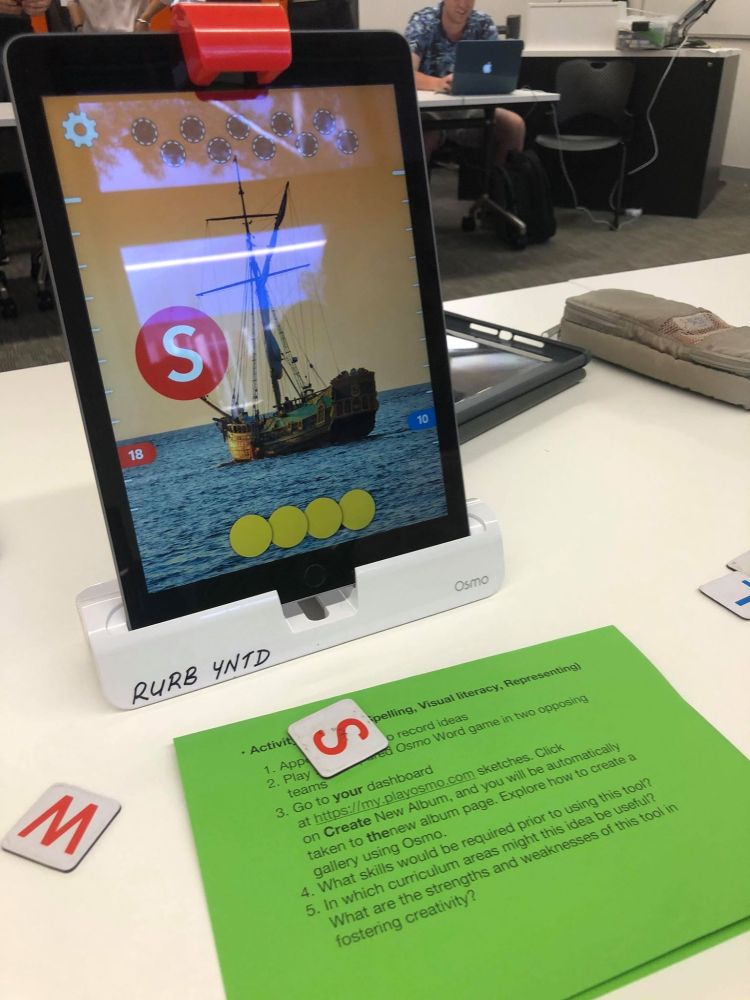
Retrieved from https://gethacking.com/blogs/news/osmo-genius-kit-review-play-smart
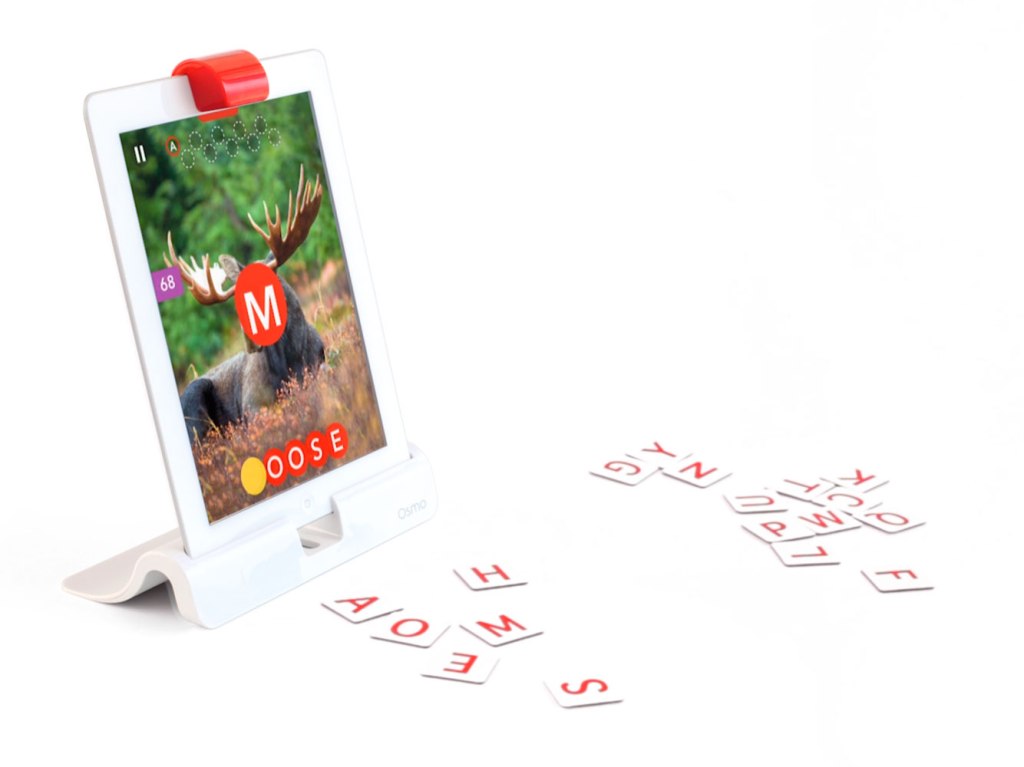
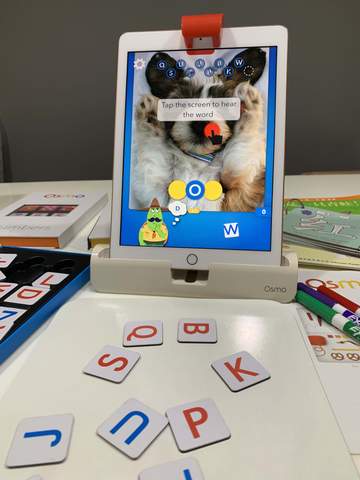
Osmo is a digital tool for iPad that combines images and sounds with tactile tools such as letter tiles. Using a stand and mirror placed over the camera, Osmo can recognise objects placed in front of the screen enabling student’s real-life experiences to overlap into the digital space. The game we played required us to place letter tiles in front of the screen in order to spell out a word associated with an image displayed on the screen. Letters were either correct and placed into the corresponding space in a word or were incorrect and resulted in the loss of a chance, similar to the classroom classic “hangman”.
At a surface level Osmo may not appear to foster creative thinking simply by having students play the game, but it is possible for students to create their own image galleries and the words associated with each image. This process requires children to engage creatively with the content they are learning and generate associations specific to their own experience. In a secondary science classroom this could be used an effective revision tool, where students each make galleries of their own that they then share with others in the class. This approach benefits student learning by both requiring students’ active engagement (Obenland, Munson & Hutchinson 2012) with content in making image galleries of their own and exposing them to the ideas of their peers.
Through activities such as this, Osmo allows for the type of interactive engagement with curriculum content that will build student’s creative capacities and readiness for the future workplace. Osmo is, however, not cheap to provide on a whole class or year scale. iPads must be available for students to use in groups not larger than 4 and the starter kit itself retails for $167 AUD, placing it outside some schools’ reach.
Reference list
Australian Curriculum, Assessment and Reporting Authority (ACARA). Critical and Creative Thinking. Retrieved at: https://www.australiancurriculum.edu.au/f-10-curriculum/general-capabilities/critical-and-creative-thinking/
Beghetto, R. A., & Kaufman, J. C. (2013). Fundamentals of Creativity. Educational Leadership, 70(5), 10-15
Obenland, C. A., Munson, A.H., Hutchinson, J. S., (2012) Silent Students’ Participation in a Large Active Learning Science Classroom. College Science Teaching, 42(2), 90-98
Pink, D. (2011). Creative fluency. In L. Crocket, I Jukes, A. Churches (Eds.), Literacy is not enough – 21st Century fluencies for the digital age. (pp. 43-54). Corwin
Triple S Games (2018). How to Play: Hangman. Retrieved at: https://www.youtube.com/watch?v=cGOeiQfjYPk
Images are my own unless otherwise specified
 EDUC3620 Digital Creativity and Learning ePortfolio
Very interesting information about the “Osmo” educational tool. I agree with the statement that Osmo can be used as an effective revisional tool that enables students to creatively engage and learn through the galleries of images which requires the students to almost recite what the image is. It can used to identify keywords or key words of a particular concept in science.
LikeLike
Hi Nathan,
I like that you discussed the importance of being creative for students to thrive in their future lives and within society. I completely agree with that statement and think finding technologies that foster this is extremely important for the classroom. Osmo sounds like a very interesting digital tool for students to increase active engagement with the content being taught and to encourage students to revise content in a more engaging way. However, as this digital tool is made for iPads it’s not as accessible as other technologies which may prevent schools from investing in this particular tool and due to it being more game-like may provoke students to become distracted and forget about the content being addressed. But I still think that when used correctly this digital tool could significantly improve engagement in the classroom and can give students the chance to be creative learners.
LikeLike
Hi Nathan,
This is a really fun and interesting technology for classrooms use. I wouldn’t have thought about its uses in a secondary setting and I think your idea is really fun and innovative! Even if some schools could only afford a limited amount of devices, there are so many different learning opportunities that can be achieved from the Osmo.
LikeLike
Hi Nathan,
I really enjoyed reading your critique. I like that you didn’t just address OSMOS positive aspects, you also incorporated some potential negative components of the technology such as cost and availability. I also felt it was important that you related the technology back to students real life experiences, and reiterated the importance of this. I also liked how you begun the blog with the importance of technology in education, and made it clear this stemmed from your own personal thoughts – how a blog should be.
Lily
LikeLiked by 1 person
Hi Nathan, I appreciate the emphasis you placed at the beginning of the blog on the importance of creativity in the primary school, but also how it is a life long skill needed for the workplace. I also agree with your points from ACARA on how students learn to think creatively. I love that this app allows students to interact with the ideas of their peers.
I enjoyed reading about the way you critically evaluated the benefits of this technology and how it could be used in the classroom. I would also be interested to learn about the limitations of the app when being used, as you spoke mainly about the price point of the app and using iPads. Is there any problems with the app ‘Osmo’? A point that I caught on too while reading your blog is how ‘Osmo’ is similar to Hangman. Could ‘Hangman’ be played instead with the same learning outcomes achieved or does Osmo provide a better learning experience for the students? This is just something I would be intrigued to find out more about after reading your blog.
Your blog design was easy to navigate and understand, Well done!
LikeLike